Weight loss for women over 40 can be harder, but not impossible. Most weight loss advice was written for someone who isn’t you. It was written for someone with eight hours of sleep, no kids to feed, no mental load running in the background at all hours, and a metabolism that still cooperates. If that’s not your life — and for most women over 40, it isn’t — then most of that advice was never going to work anyway.
Here’s what’s actually going on, and what actually helps.
I’ve watched this up close. My wife navigates the same reality millions of women do — the exhaustion, the shifting body, the mental weight that never fully switches off. What I’ve learned from watching her, and from years of working in health and fitness, is that most women aren’t failing because they’re not trying hard enough. They’re failing because they’re following the wrong game plan for where they are right now.
That’s what this article is about.
Disclaimer: This article is for informational purposes only and is not a substitute for professional medical advice. Always consult your doctor before starting any new fitness or nutrition program.
⚡ Quick Answer
Quick Answer: Weight loss for women over 40 is harder because of real biological shifts — dropping estrogen, rising cortisol, slower metabolism, and muscle loss. But it’s not impossible. The formula that works: build muscle through strength training, get protein in at every meal, manage stress and sleep like they’re part of your training, and fix the mindset that’s been running the wrong program for years. No crash diets. No punishing yourself into results. Just a smarter approach for where you actually are.
Your Body Changed. Your Approach Has To Change Too.

At 40 something shifts. You didn’t imagine it. You’re not being dramatic. The body you had at 28 operated on a different set of rules, and what worked then — eating less, doing more cardio, cutting out carbs for two weeks — doesn’t produce the same results anymore.
Here’s the honest biology: muscle mass starts declining in your 30s and accelerates after 40. Less muscle means a slower resting metabolism, which means your body burns fewer calories doing nothing. At the same time, estrogen begins to drop, and fat starts redistributing — moving away from the hips and thighs and settling around the abdomen instead. None of this is your fault. It’s physiology.
The women who make real progress after 40 aren’t the ones who push harder on the same old approach. They’re the ones who accepted that the game changed and adjusted accordingly. That’s the only move that works.
The Hormone Problem — and What You Can Actually Do About It
Hormones are running more of your body’s decision-making than most people realize. After 40, several key ones shift in ways that directly affect your weight, your energy, your mood, and how your body stores fat. Research shows that muscle mass declines 3–8% per decade after age 30, accelerating further after 40 — and that’s before hormones even enter the picture.
Estrogen drops as you approach perimenopause and beyond. Lower estrogen signals your body to store more fat, particularly around the belly. This isn’t a willpower failure. It’s your body responding to a hormonal instruction it’s been given.
Cortisol — your primary stress hormone — becomes more problematic as estrogen drops, because estrogen actually helps buffer cortisol’s effects. When that buffer is reduced, stress hits harder and lingers longer. And here’s what matters for weight: when cortisol stays elevated, your body holds onto fat as a survival mechanism. It thinks you’re under threat. It’s trying to protect you. The problem is, it can’t tell the difference between a physical threat and the mental load of running a household, managing a career, and raising children.
Insulin sensitivity also decreases with age, meaning carbohydrates — especially processed ones — hit your system harder than they used to. The same plate of pasta that felt fine at 30 now spikes your blood sugar faster and stores more readily as fat.
And then there’s the reality that rarely gets talked about honestly: motherhood itself is a long-term physical and neurological stressor. Not because children aren’t worth it — but because the job never stops. You’re always on. Always listening for something. One ear open while you sleep. The mental load of anticipating everyone else’s needs runs 24 hours a day, 7 days a week. That’s not stress in the dramatic sense — it’s chronic low-grade cortisol elevation that accumulates over years. Add the sleep deprivation of infants and young children on top of that, and you have a nervous system that never fully resets. One that runs in protective mode constantly.
That’s not laziness. That’s survival. And it takes a real toll on the body’s ability to regulate weight, energy, and recovery.
What you can do about it:
- Reduce processed carbs — not eliminate them, just reduce. Whole food carbs (oats, rice, sweet potatoes, fruit) affect insulin far more gently than packaged food does.
- Treat stress management as part of your health plan — not optional, not self-indulgent. It’s metabolic. Chronic cortisol keeps the body in fat-storage mode.
- Prioritize sleep — even partial improvements matter. More on this below.
- Don’t ignore the mental load. If the nervous system never gets to rest, the body can’t recover properly. That’s not a mindset issue — it’s biology.
Nutrition — What Actually Works for Weight Loss for Women Over 40
The diet trap most women fall into after 40 looks like this: eat less, feel miserable, lose a few pounds, stall, give up, gain it back. Repeat. The problem isn’t discipline. The problem is that severe calorie restriction causes the body to break down muscle for energy — and less muscle means a slower metabolism. You’ve made the underlying problem worse.
Here’s what actually works.
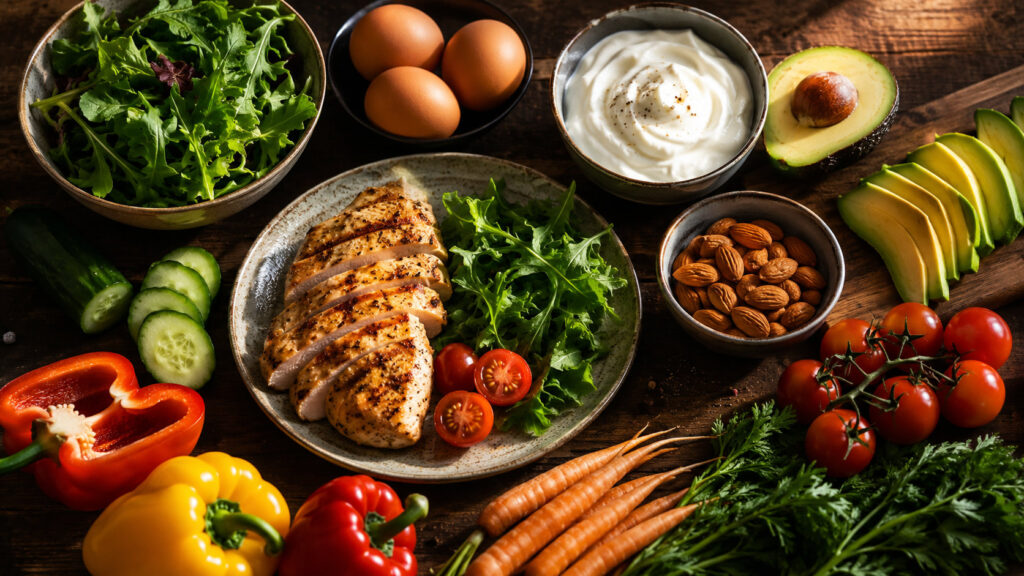
Protein is the non-negotiable. It builds and preserves muscle. It keeps you full longer than carbs or fat. It has the highest thermic effect of any macronutrient — meaning your body actually burns more calories digesting it. Women over 40 who aren’t getting enough protein are fighting a losing battle on every front. Aim for a source of protein at every single meal: eggs, chicken, fish, Greek yogurt, cottage cheese, legumes. This isn’t optional.
Whole foods over processed — not because processed food is evil, but because it’s engineered to make you eat more of it and it wrecks your blood sugar in ways that your post-40 insulin sensitivity can’t handle as well as it used to. This doesn’t mean perfection. It means the majority of what you eat comes from real ingredients.
What to cut without suffering:
- Liquid calories — soda, juice, fancy coffee drinks loaded with syrup. They add up fast and do nothing for hunger.
- Ultra-processed snacks. Not because they’re “bad” but because they trigger more eating and give nothing back nutritionally.
- Mindless late-night eating. If you’re hungry after dinner, it’s often dehydration or habit, not actual hunger. A glass of water and ten minutes usually confirms which one it is.
What to keep:
- Carbs — especially around training. They fuel your workouts and support recovery.
- Healthy fats — avocado, olive oil, nuts. They support hormone production, including the hormones you need.
- Fiber. It slows digestion, stabilizes blood sugar, and keeps you full. Vegetables, legumes, oats.
The simplest framework that works: eat enough protein, control portions of everything else, and stop making food the enemy. Restriction breeds obsession. Eating real food in sensible amounts breeds results.
For a starting point on your actual calorie needs, the BMM369 Calorie Calculator gives you your daily target, protein goal, and more — based on your numbers, not a generic template. → Use the Free Calorie Calculator
Protein and Creatine — Two Supplements Actually Worth Taking After 40
Not every supplement deserves a place in your routine. These two do.
Protein powder isn’t a bodybuilder thing — and it’s not artificial food either. Whey comes from dairy. It’s real protein, just packaged differently for convenience. Think of it as an extra intake option — replace a small meal, have it as a late night snack when cravings hit, or drink it before bed when hunger starts pulling you toward the wrong things. A shake with a scoop of creatine mixed in kills the craving, kills the hunger, and delivers real nutritional benefits at the same time. That’s a win on every level.
Not all protein powders are equal though. Most are heavy on the stomach — bloating, discomfort, that uncomfortable fullness that lingers. For women over 40 whose digestive systems are already more sensitive, that matters. Hydrolyzed whey protein is broken down further than standard whey, meaning it absorbs faster and sits far easier on the stomach. Dymatize ISO100 is the one I personally use and recommend — clean, hydrolyzed, and genuinely easy to digest in a way most proteins aren’t.
Creatine is the other one — and it’s one of the most misunderstood supplements out there, especially for women. The gym-bro reputation it carries has kept a lot of women away from something that actually benefits them more as they age, not less.
Here’s what creatine actually does: it supports muscle strength, helps your muscles recover faster between sessions, and — critically for women over 40 — it helps preserve the muscle mass your body is actively trying to break down. There’s also growing research around creatine’s benefits for cognitive function and energy, both of which take a hit as estrogen drops.
You don’t need to load it, you don’t need to cycle it, and it won’t make you bulky. A small daily dose — typically 3 to 5 grams — mixed into water or your protein shake is all it takes. Optimum Nutrition-Micronized Creatine is a clean, no-filler option worth keeping in your stack.
Neither of these replaces real food or real training. But for women over 40 trying to preserve muscle, stay consistent, and recover properly — they’re two of the few supplements that actually earn their place.
Exercise — What Women Over 40 Actually Need to Be Doing

When it comes to weight loss for women over 40, most have been given the wrong advice for a long time.
The instinct when you want to lose weight is to do more cardio. Run more. Cycle more. Hit the treadmill harder. And cardio has its place — it’s good for your heart, your mood, your stress levels, and your daily calorie burn. But cardio alone is not your fat loss engine after 40. Muscle is.
Muscle tissue burns calories at rest. The more of it you have, the higher your resting metabolic rate — meaning your body burns more just existing. After 40, when metabolism is already slowing and muscle is already declining, building and preserving muscle through strength training is the single most effective long-term fat loss strategy you have.
What that looks like in practice:
- Strength training 2–3 times per week. You do not need to become a powerlifter. Compound movements that work multiple muscle groups at once — squats, deadlifts, rows, chest presses, lunges — are efficient and effective.
- Start with bodyweight if you’re new to it. Progression comes naturally.
- Allow recovery between sessions. After 40, your joints and connective tissue need it. Training hard twice a week with good recovery beats training mediocre five days in a row.
Cardio’s role: Keep it. Two to three sessions of moderate cardio per week is great for heart health and stress management. Walking especially. Walking is underrated to the point where it’s almost embarrassing. Thirty minutes a day, done consistently, contributes more to long-term fat loss than most people realize — and it costs your body almost nothing in recovery.
If you want a complete framework for training after 40, the principles in Getting Fit After 40 translate well — even though it’s written from a male perspective, the fundamentals of strength, recovery, and consistency apply equally.
Mindset — The Real Reason Most Women Stall

This is the section most weight loss articles skip entirely. And it’s the most important one.
A lot of women over 40 aren’t just dealing with a slower metabolism. They’re carrying decades of mental weight around food and their bodies. Diet culture has been running a program in the background since they were teenagers — restriction is discipline, hunger is success, any weight gain is failure. That program is still running. And it’s working against them.
Here’s what that looks like in practice:
All-or-nothing thinking. One bad meal becomes a bad day becomes a bad week. “I already ruined it, so I might as well.” This single pattern destroys more progress than any diet could ever recover.
Identity as a struggle. “I’ve always had a slow metabolism.” “I’ve always been heavy.” “I just can’t lose weight.” The body hears every story you tell about yourself and adapts accordingly. If you’ve decided what’s possible, you’ve already set the ceiling.
Comparing yourself to who you were at 28. That’s the wrong benchmark. That woman lived in a different body with different hormones and probably different responsibilities. Chasing her is a race you can’t win. The goal isn’t to go back — it’s to build forward.
The guilt cycle. Eat something “bad,” feel guilty, restrict, feel deprived, eat more than planned, feel guilty again. Round and round. This isn’t a discipline problem. It’s a mindset loop that needs to be broken, not pushed through harder.
The reframe that actually works: this is not about returning to who you were. It’s about building who you’re becoming. Small consistent actions, repeated daily, produce results that no crash diet ever has. You don’t need the perfect plan. You need the right mindset followed by enough consistency to let it compound.
That’s what the 369 Method is built on. Write your goal three times in the morning. Say it six times at midday. Visualize it nine times before sleep. It sounds simple because it is. But it works because it keeps your focus where it belongs — on what you’re building, not what you’ve lost.
Sleep and Stress — The Two Fat Loss Killers Nobody Wants to Talk About
Let’s be honest about something first.
After a full day of work, kids, cooking, school runs, appointments, and every other responsibility that lands in a woman’s lap — the quiet hour at the end of the night is sacred. The TV goes on. Maybe a glass of wine. Nobody needs anything from you. You can finally just be still. That’s not laziness. That’s survival. And nobody should be telling you to give it up.
But here’s the honest conversation about what that hour is doing to your sleep — and therefore your results.
When cortisol is elevated from a full day of stress and mental load, your body needs time to genuinely wind down before sleep becomes restorative. High-stimulation content — arguments on social media, tense dramas, anything that keeps your nervous system in alert mode — keeps cortisol elevated even while you’re lying down. That delays the quality of sleep your body needs to regulate hunger hormones, repair muscle, and reset for the next day.
The compromise that actually works:
- Keep the quiet evening. Keep the TV. You’ve earned it.
- Shift toward something slower — a show that makes you laugh rather than one that makes your heart race. A movie instead of the news.
- Dim your screen brightness in the evening. The blue light suppresses melatonin and delays sleep onset.
- One glass of wine is genuinely relaxing. Two or three disrupts your sleep architecture in the second half of the night — even if you fall asleep fine. That’s when your body does its deepest recovery work.
- Aim to be in bed with lights off by 10–10:30 if possible. The hours before midnight count more for recovery than the ones after.
The biology matters here: poor sleep raises ghrelin (the hunger hormone) and lowers leptin (the satiety hormone). You wake up hungrier, with less willpower, and your body is primed to crave high-calorie food. One bad night of sleep can undo a week of good decisions at the table.
Stress is the other side of this. Chronic stress — the kind that accumulates from years of always being needed, always being on, always anticipating the next thing — keeps cortisol elevated even when nothing acute is happening. And elevated cortisol tells your body to store fat, particularly around the abdomen. Managing stress isn’t a wellness luxury. It’s a metabolic necessity.
I deal with stress and hypertension myself. I know what it feels like when the body is running too hot for too long. You can’t outwork a system that’s in survival mode. You have to address the source.
Start Here This Week — Practical Wins That Build Momentum
You don’t need a twelve-week plan. You need a starting point. Here are six things you can do right now that will move the needle — no gym membership required for most of them.
1. Add protein to every meal. Eggs at breakfast. Chicken or fish at lunch. Whatever you’re already cooking at dinner — add a protein source if there isn’t one. This one change alone will reduce hunger, preserve muscle, and support your metabolism.
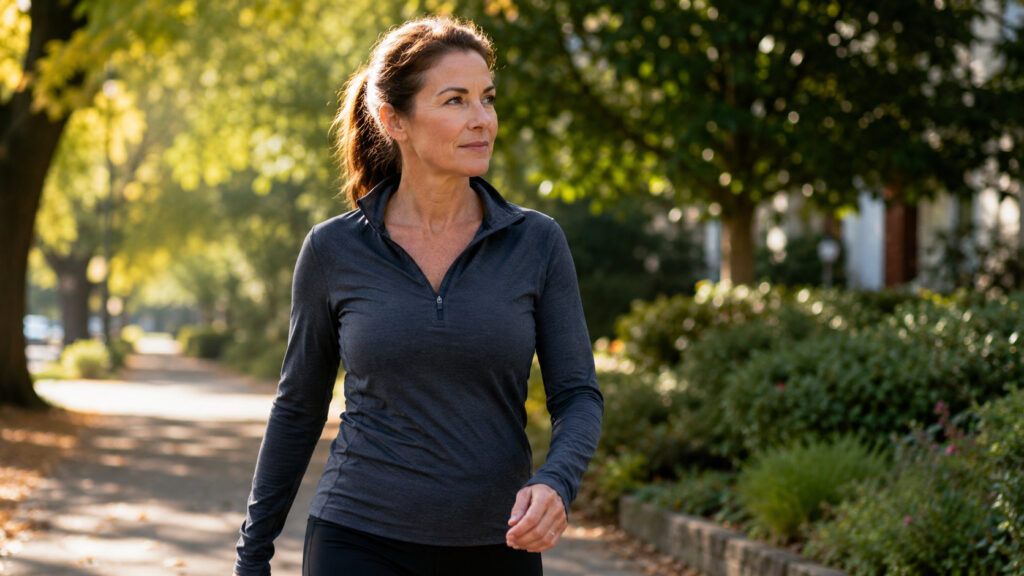
2. Walk 30 minutes every day. Not as exercise. As medicine. Get outside if you can. It lowers cortisol, burns calories with zero recovery cost, and compounds significantly over time.
3. Cut liquid calories. Soda, juice, sweetened coffee drinks. These are stealth calories that don’t register as fullness. Water, black coffee, herbal tea. Simple swap, meaningful impact.
4. Start two strength sessions per week. You can start at home. Squats, lunges, push-ups, and a resistance band for rows cover the major muscle groups. Twenty minutes, twice a week. That’s enough to start.
5. Stop weighing yourself daily. The scale measures water, food volume, hormonal fluctuation, and about fifty other things that have nothing to do with fat loss. Track how your clothes fit. Track your energy. Track whether you’re getting stronger. The scale is one data point — not the verdict.
6. Give yourself a mindset structure to follow. This is where most people stall — not because they lack willpower, but because the mind keeps pulling them back to old patterns. The free 369 Fitness Planner gives you a simple daily structure to keep your mindset locked on your goal — morning, midday, and evening — so the habits actually stick.
Find out your exact daily calorie target, protein goal, BMI, water intake, and recommended steps — in under a minute. → Use the Free Calorie Calculator
You’re Not Starting Over. You’re Starting Smarter.
Weight loss for women over 40 starts the moment you stop chasing who you were and start building who you’re becoming. Stop fighting your biology and start working with it. Stop punishing yourself for what didn’t work and start building something that does.
Stronger. Leaner. Clearer. Not by doing more — by doing the right things consistently.
That’s the only formula that’s ever worked. And it works at 40, at 50, at any age you decide to start.
Dream. Act. Elevate.
Disclaimer: This article contains affiliate links. If you purchase through them, I may receive a small commission at no extra cost to you.